
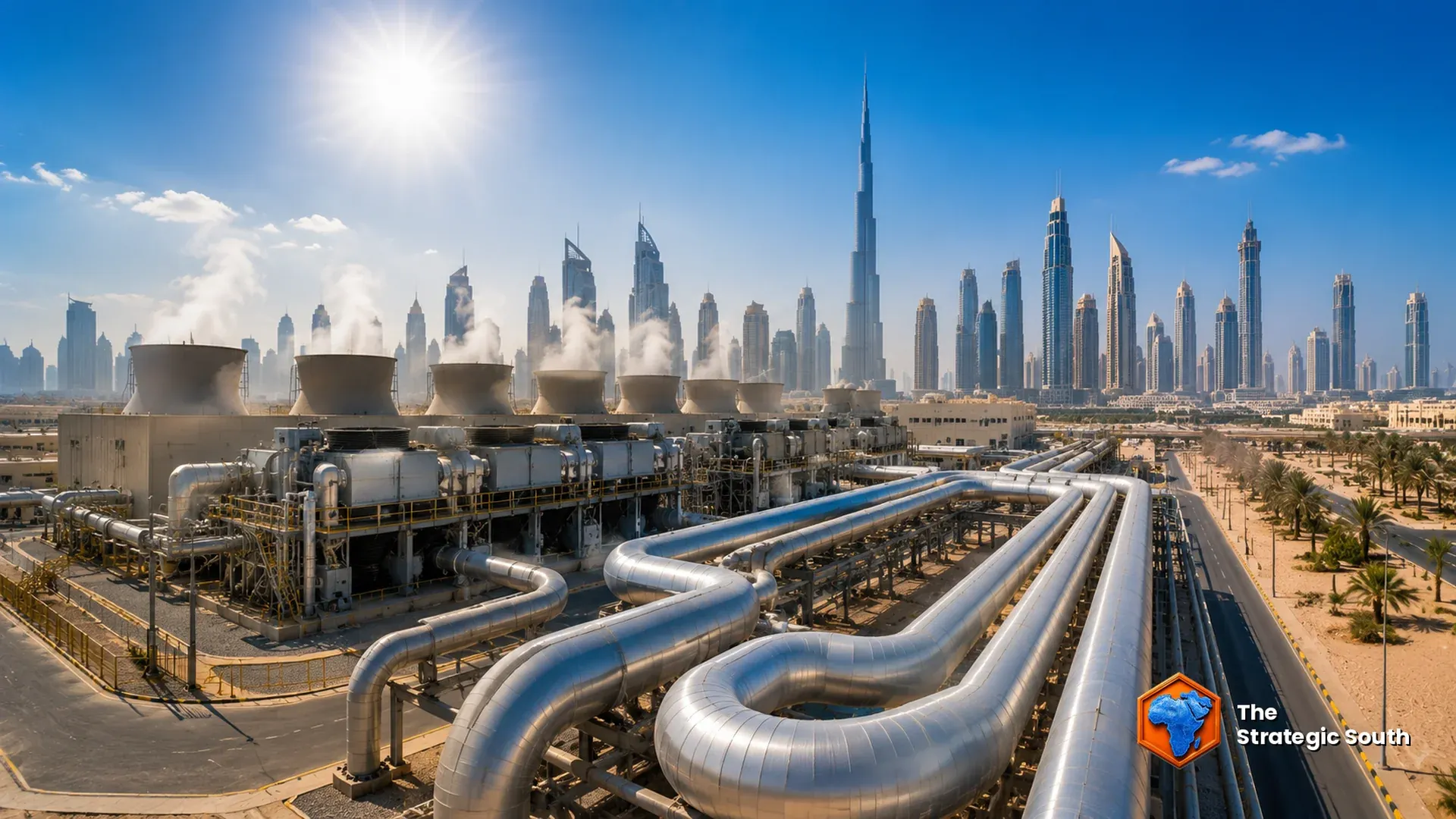
Three of us, and sixty desks
My first trade was reservoir geophysics, in a technical centre on the edge of a North African megacity. The centre held about sixty people; the reservoir team inside it was three. It sat in a tax-free economic zone at the edge of town, and I spent my first working years there reading seismic images for oil companies.
What I did not appreciate at the time is that the most critical system in that building was not the one we worked on. It was the air-conditioning.
Nobody thinks of it that way. Cooling gets filed under comfort, alongside carpet and lighting. But in that climate it was not an amenity of the building. It was the condition under which any work happened at all — sixty people and the machines they sat in front of, every one of them producing heat, all of them dependent on a system rejecting that heat continuously and without a gap. Take the cooling away and the offices empty within the hour, and the workstations follow not long after. A computing floor in that climate stops for lost cooling as surely as it stops for lost power. The only difference is how many minutes you get.
That is one small building. Now scale the same dependency to a Gulf city, and you have the subject of this piece.
The load everyone designs around, and no one headlines
Every delivery engineer in a hot climate knows this in their gut: air-conditioning is the load the whole design bends around. It gets sized first and celebrated never. On a power system, the load defines everything upstream of it — the plant, the network, the reserve margin all exist to serve it. Cooling is the largest load most of these systems will ever see, and it is quietly treated as decoration.
At the scale of a Gulf city that is expensively wrong. For much of the year, in much of the region, cooling is the infrastructure — the single largest claim on the grid, and the quiet arbiter of what else the place can afford to build.
The hidden half of the grid
On a peak summer day, a striking share of a Gulf city's electricity goes to one job: staying cool. By some estimates, cooling and desalination together approach half of peak power demand in parts of MENA. Half of the most expensive hours of the year — the ones that size the entire generation fleet — spent moving heat outside and turning seawater into something drinkable.
To anyone who has planned or delivered a grid, that number is not a statistic; it is a design constraint. The peak is what sizes the plant, the network and the reserve margin — everything upstream is built to survive the worst hour of the worst day. In this region, that worst hour is a cooling hour. So the question planners reflexively ask — how much power can we generate? — is the wrong one. The sharper question, the one that actually governs cost and emissions, is how much of it simply goes to staying cool.
Every new district, tower and factory adds to that load, and it compounds: a hotter decade and a growing city push the peak up together. Planning for the summer peak is, in practice, planning for cooling. Get it right and the grid breathes — you free capacity for industry, for exports, for the things the region actually wants to be known for. Get it wrong and you are building power stations to run air-conditioners at their least efficient, and locking that bill in for the life of the asset.
Centralised beats scattered
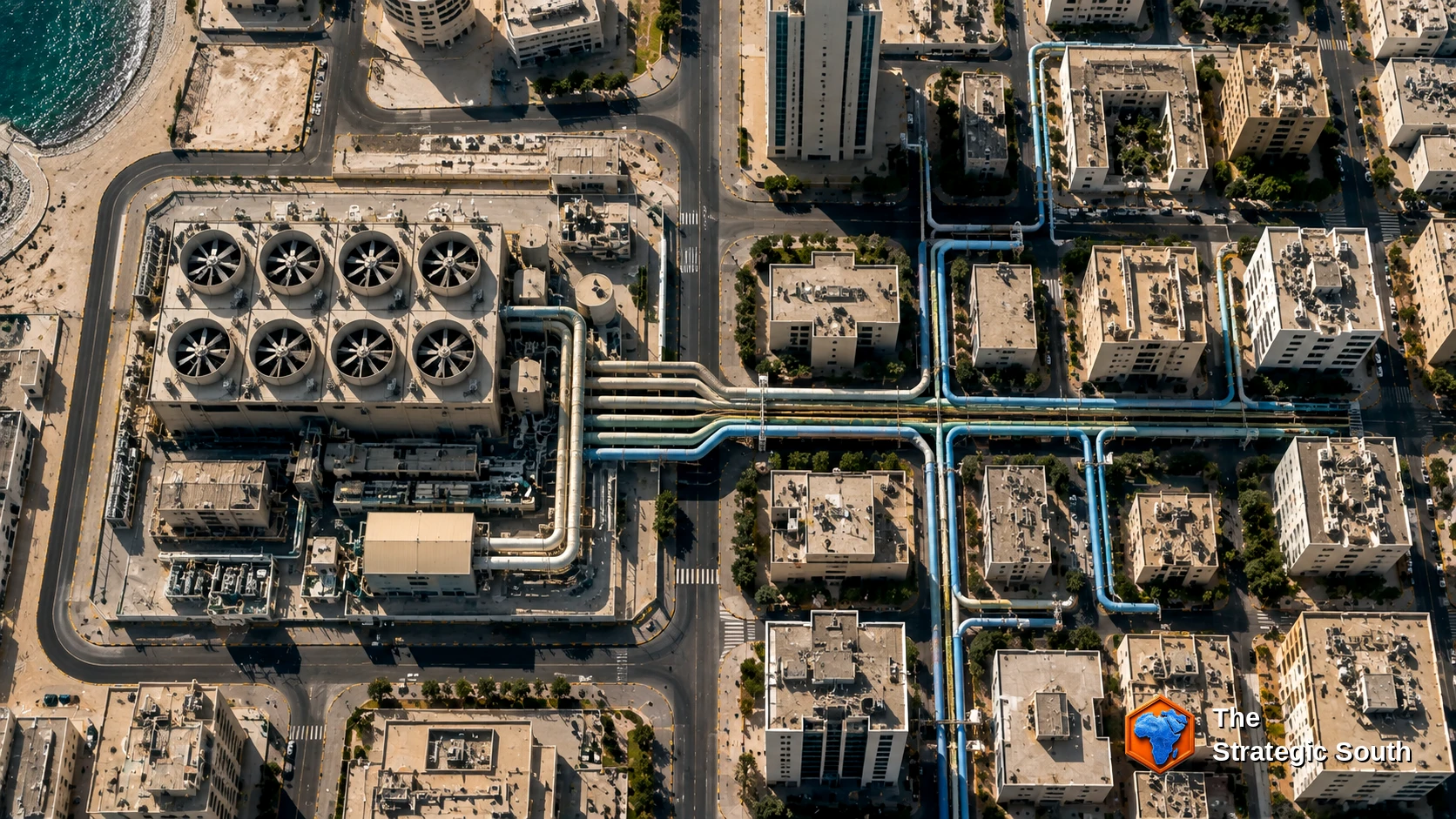
The most efficient answer is usually centralised. Instead of thousands of units each fighting the heat alone, a district-cooling plant chills water once, at scale, and pipes it to whole neighbourhoods. The engineering is unglamorous — chillers, pumps, insulated loops, a control room — and the gains are large. By some accounts these systems cut cooling energy by around 30 per cent against scattered split units.
Thirty per cent is not a rounding error at this scale; it is generating capacity you never have to build. Pair a district scheme with clean power and thermal storage — make ice at night when the grid is slack, melt it through the afternoon peak — and you shave the peak itself, cutting cost, emissions and the size of the plant behind it all at once. Shaving the peak is the single most valuable thing you can do to a grid, and cooling is where the biggest peak in the region lives.
Efficiency is capacity
This is the trade-off I have spent a career on, and every grid operator knows the logic in their bones: the cheapest unit of capacity is the one you never have to produce. A megawatt saved at the load is worth more than a megawatt built at the plant — it carries no fuel bill, no transmission loss and no emissions, and it is there on the hottest afternoon, precisely when new capacity is hardest to bring on.
That is not an efficiency footnote; it is a reliability strategy. On a grid, availability is the only currency that counts — a plant that cannot deliver at the peak is not capacity, it is decoration. Efficiency at the load behaves like firm capacity: never dispatched, never tripping in the heat, never waiting on fuel.
“The cheapest megawatt is the one cooling never has to waste — efficiency at this scale is a power plant that never has to run.”

Cooling is what the next economy is built on
None of this stays theoretical, because the Gulf's next economy makes the cooling problem bigger, not smaller. The AI data centres the region is racing to build are, at bottom, enormous heat problems dressed up as computing ones — every rack of silicon is a radiator that must be cooled continuously or it fails. In delivery terms, a data hall is not a computing asset with a cooling requirement. It is an availability problem, and heat rejection is where it fails first. Lose the cooling for minutes and you lose the load. That is the same dependency I sat inside as a young engineer in a sixty-desk technical centre, only with a billion dollars of silicon behind it and no tolerance at all for an hour without chilled water.
Industry, logistics, cold chains and desalination all rest on the same foundation: rejecting heat, reliably, in one of the hottest inhabited environments on earth. That inverts the usual hierarchy. We tend to add cooling once the real infrastructure — the data hall, the plant, the port — is built. In this region it is the other way round. Reliable, efficient cooling is the precondition for the growth, not a side effect of it.
Put plainly: in a warming region, the ability to cool is the ability to build. Every gigawatt of data centre the Gulf announces assumes a cooling system underneath it that actually works — an assumption doing far more load-bearing than the headline ever admits.
A shared utility is not something you bolt on at the end
Here is where my own trade makes me impatient. On any industrial or power project, the recurring temptation is to treat a shared utility — power, water, cooling — as an item you procure last. Design the plant, then fit whatever the budget has left. Delivery teaches the opposite, usually the hard way: a shared utility is a system with a thirty-year operating life, not a component, and it has to be specified, owned and staffed as one from the first week of design. It is also where responsibility blurs between parties, which is why it fails long before any single piece of equipment does.
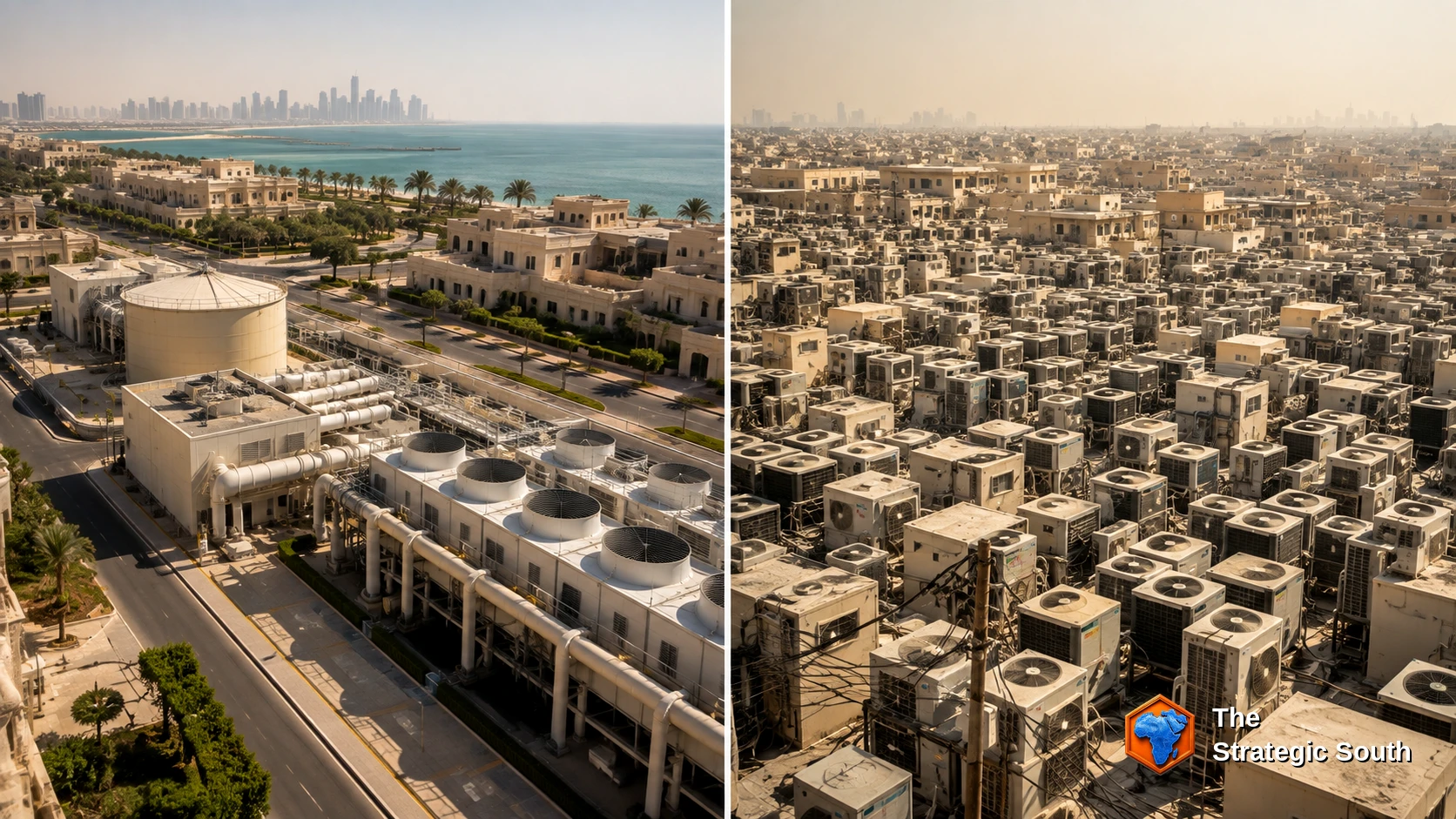
Cooling in the Gulf is that mistake waiting to happen at the scale of a city. Left as a commodity — every tower buying its own units, every developer optimising its own plot — you get the least efficient system physics allows and a grid that pays for it forever. Engineered as infrastructure — planned centrally, owned deliberately, sized against the whole district — it becomes one of the cheapest strategic assets the region has.
And the part my trade insists on hardest: you do not just build it, you operate it. A cooling network is judged over thirty summers, not on the day it is commissioned. So the real choice is not technical. It is whether cooling gets a named owner accountable for its availability for decades, or gets assumed. The systems that fail are the ones everybody assumed and nobody was accountable for.
The cost of the victory shows up every summer
There is an irony the region lives every July. Oil is what let the Gulf conquer its climate — cheap energy built glass cities where the human body was never meant to last half the year. That victory was real, and it was extraordinary. But the bill for it now arrives on the grid, as a load curve that spikes with the thermometer, and the resource that made the conquest possible is the same one being burned to sustain it.
That is a manageable position, but only if cooling is treated as what it has become: not a comfort to be assumed, but infrastructure to be engineered and then operated for the long haul. The region that masters it — that squeezes the 30 per cent out, anchors it in centralised plant, thermal storage and clean power, and owns it end to end — keeps its generating capacity free for everything else it wants to become. The region that keeps filing cooling under comfort will spend its future paying, in fuel and in plant, simply to stand still.
Two in the afternoon, forty-six degrees
Let me finish on an hour I have not stood in. This is a projection, not a memory — but it is the hour every system described above is sized against, and the arithmetic behind it is not in doubt.
Picture two in the afternoon in August. Forty-six degrees on the thermometer, the asphalt soft, the light gone white over the bay. Behind the glass the towers hold twenty-two while the sea steams outside. Somewhere under the city a chilled-water loop runs flat out; on the edge of town the transmission lines sag and the last turbine on the fleet spins up to hold the frequency. That single hour is where the region's summer is decided — not in a keynote, but in a control room where a load curve either holds or it does not.
There are two versions of that afternoon, and the choice between them is being made now, in design offices and procurement schedules. In one, the peak arrives and there is slack in the line, because someone froze a reservoir of ice at three in the morning and is melting it now, because a district plant is doing the work of ten thousand rattling units, because a person nobody outside the building can name has been accountable for this exact afternoon for thirty summers running. In the other, every rooftop compressor screams at once, the reserve margin thins to nothing, and a new power station burns gas at the worst possible moment to buy back the efficiency nobody engineered in.
Same skyline, same heat, same sea. The difference is entirely in who owned the load before the thermometer reached forty-six — and that difference is what you feel, or fail to feel, when you step out of the sun and the cool air holds. In a warming world that hour is spreading north and inland, to Mediterranean streets and industrial parks that never used to plan for it. The Gulf reaches it first, every year. The city that keeps its towers cool through that afternoon will be the one that treated the coldest air in the building as the most serious thing it built.
The Strategic South examines how engineering, infrastructure, energy and industrial systems are reshaping Africa and the Middle East — through the lens of project delivery, not press releases. Subscribe to the weekly newsletter, and explore the companion pieces.