
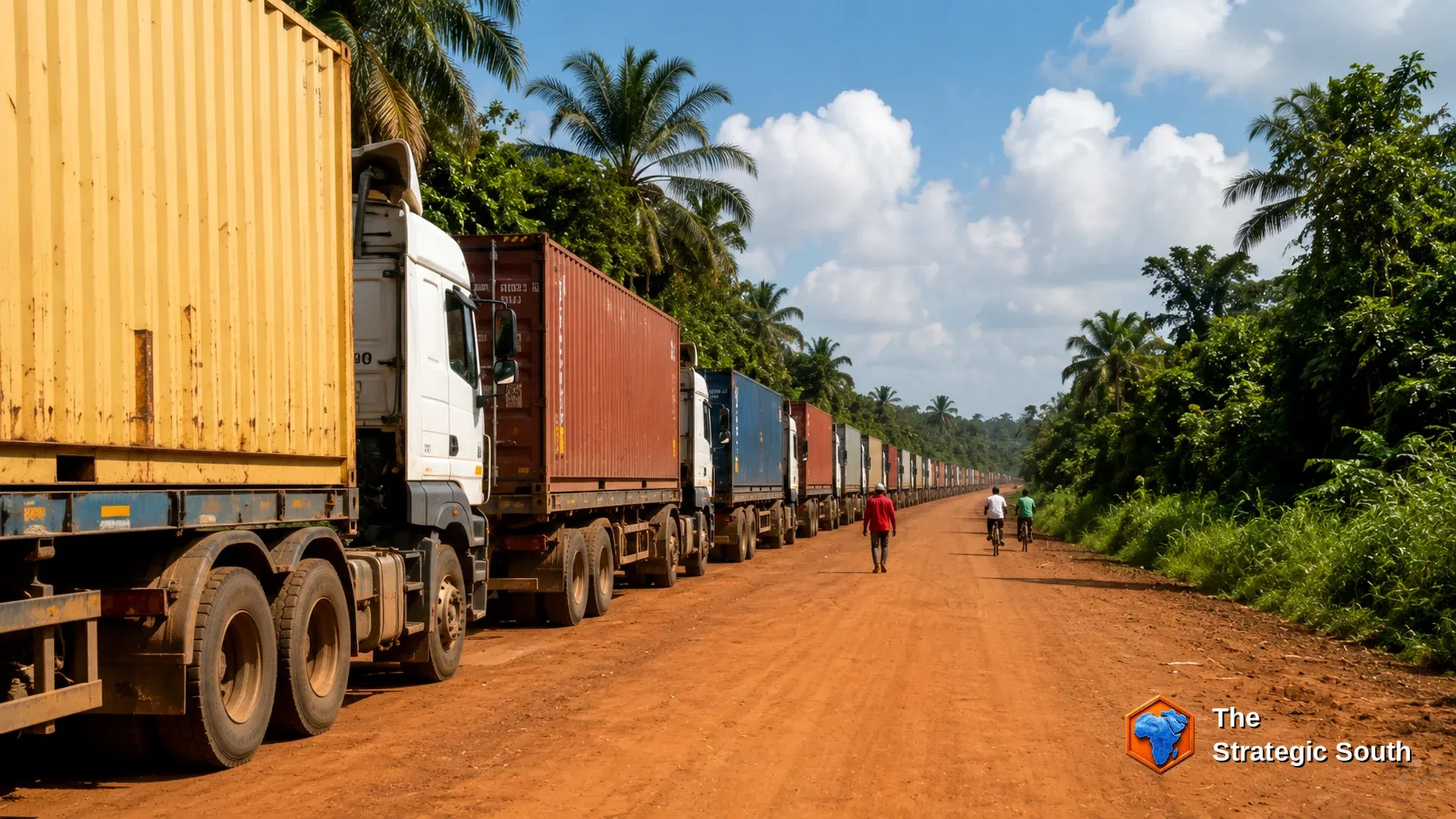
One kilometre, one to three months
For years we flew the processed results of our subsurface studies in from Europe. Interpretation volumes, reports, the finished output of work that had already taken months and a good deal of money to produce, and that a team on the ground was waiting on to decide where to drill.
The flight took a few hours. The last kilometre took between one and three months.
Our West African office sat barely a kilometre from the airport — close enough to watch the aircraft on approach from outside the building. Between the aircraft and the office was a sequence, and the sequence was the whole problem. The shipment landed and was held. It had to be declared. The declaration had to be registered. The registration had to be matched to a document that had travelled separately. Something had to be inspected, then released, then physically collected and driven the kilometre.
Every one of those steps had an owner. Not one of them belonged to anyone whose job was to get the thing to the next step. Each desk did its own task correctly, when the task arrived in front of it, and then did nothing further, because nothing further was its task.
So the file advanced on the days we asked, and stood still on the days we did not. Ask on Monday and something moved on Monday. Go quiet for a fortnight because a well was in trouble and there was a fortnight of nothing waiting for you when you came back. It was never obstruction. Nobody was extracting anything. It was simply a chain in which forward motion was an optional extra, supplied from outside, by us, every single day.
One to three months, for one kilometre. The variance was the tell. A month was what the sequence cost when someone pushed it daily. Three months was what it cost when nobody did.
I think about that kilometre whenever someone tells me Central Africa's problem is infrastructure. The region is routinely described as short of ports, railways and roads. On the ground, that is rarely what I have watched hold a project back. The asset was almost always there, and usually in working order. What was missing sat in the gaps between the assets, and nobody had been given it.
A corridor is a chain of handoffs, not a line on a map
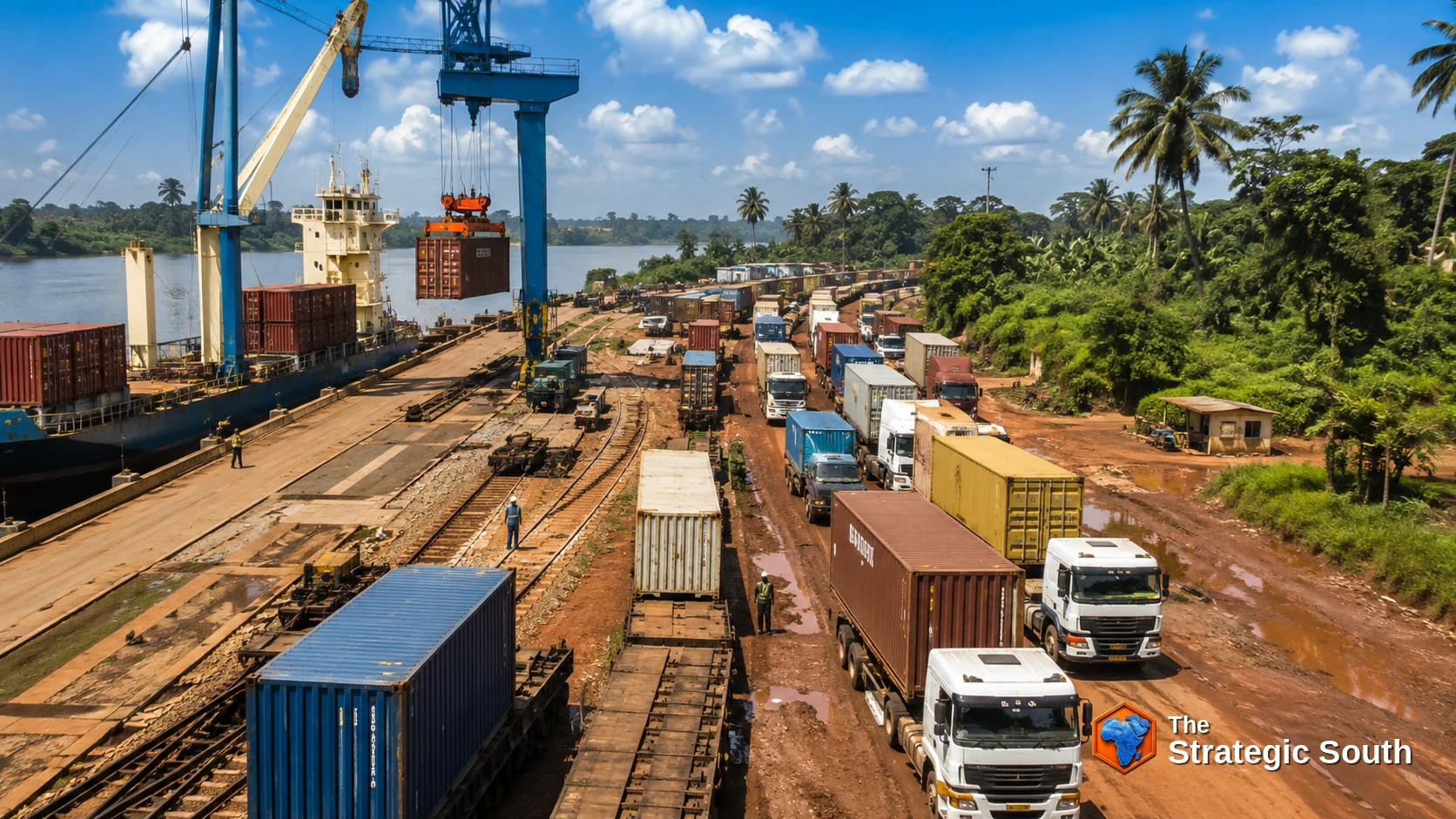
We draw corridors as clean lines: port, rail, road, border, inland market. What actually exists is a chain of handoffs, and every handoff is a place where cargo can stop. The ship arrives on time; the container waits for customs. The truck is ready; the paperwork is not. The road is freshly surfaced; the release that lets the next leg start is sitting three desks away, in an office nobody has phoned today.
Central Africa runs that pattern at regional scale. Douala is the maritime gateway for landlocked Chad and the Central African Republic. Kribi adds deep water for larger vessels and, in time, for industry. The railway runs inland towards Ngaoundéré, and from there freight continues by road to N'Djamena. Taken one at a time, these are perfectly respectable assets. Taken together, they are supposed to behave as a single regional logistics system, because a landlocked economy does not depend on any one of them. It depends on all of them working in sequence, at a speed you can predict.
Which is why one more road or one more terminal so often changes less than the announcement promised. You have upgraded a link, not the chain. And a chain's performance is set at its weakest join, where two organisations meet and neither is accountable for what happens in between. A port authority optimises the port. A rail operator optimises the rail. A customs service optimises its own throughput. Each of them can be measured, audited and found to be performing well, while the journey from ship's rail to inland warehouse belongs to nobody at all. The cargo experiences the whole chain. Each institution sees only its link.
A corridor is only as fast as the slowest desk nobody owns.
The waiting is the expensive part
Delay has a price, and it is much larger than the freight bill that everyone stares at.
An asset standing idle, a crew on standby, a plant running at half capacity, a rig or a site team waiting on material that cleared the port three weeks ago — these burn money quietly, in currencies that never appear on a logistics invoice. Concrete is paid for once, at a number everybody can see and argue about. Waiting is charged by the day, to no budget line in particular, which is exactly why it survives.
And the bill lands well beyond the project that pays it first. Industry does not invest in an asset; it invests in confidence. A miner needs export logistics it can commit to. A food processor needs the same delivery every week, not a good average. A manufacturer weighs the whole chain before signing a lease, not the port, and certainly not the map. Transit time you cannot predict is a tax on every factory a corridor was meant to attract, and it is paid in inventory held as insurance against a border. For Chad and the Central African Republic, a transit time you can plan around is worth more than several hundred kilometres of distance saved.
You cannot import a delivery model
It is tempting to read all this as a story about people who do not deliver. I have watched colleagues who built their careers in mature markets arrive, hit this friction in their first month, and reach exactly that conclusion. They are wrong, and the mistake is expensive — mostly to them.
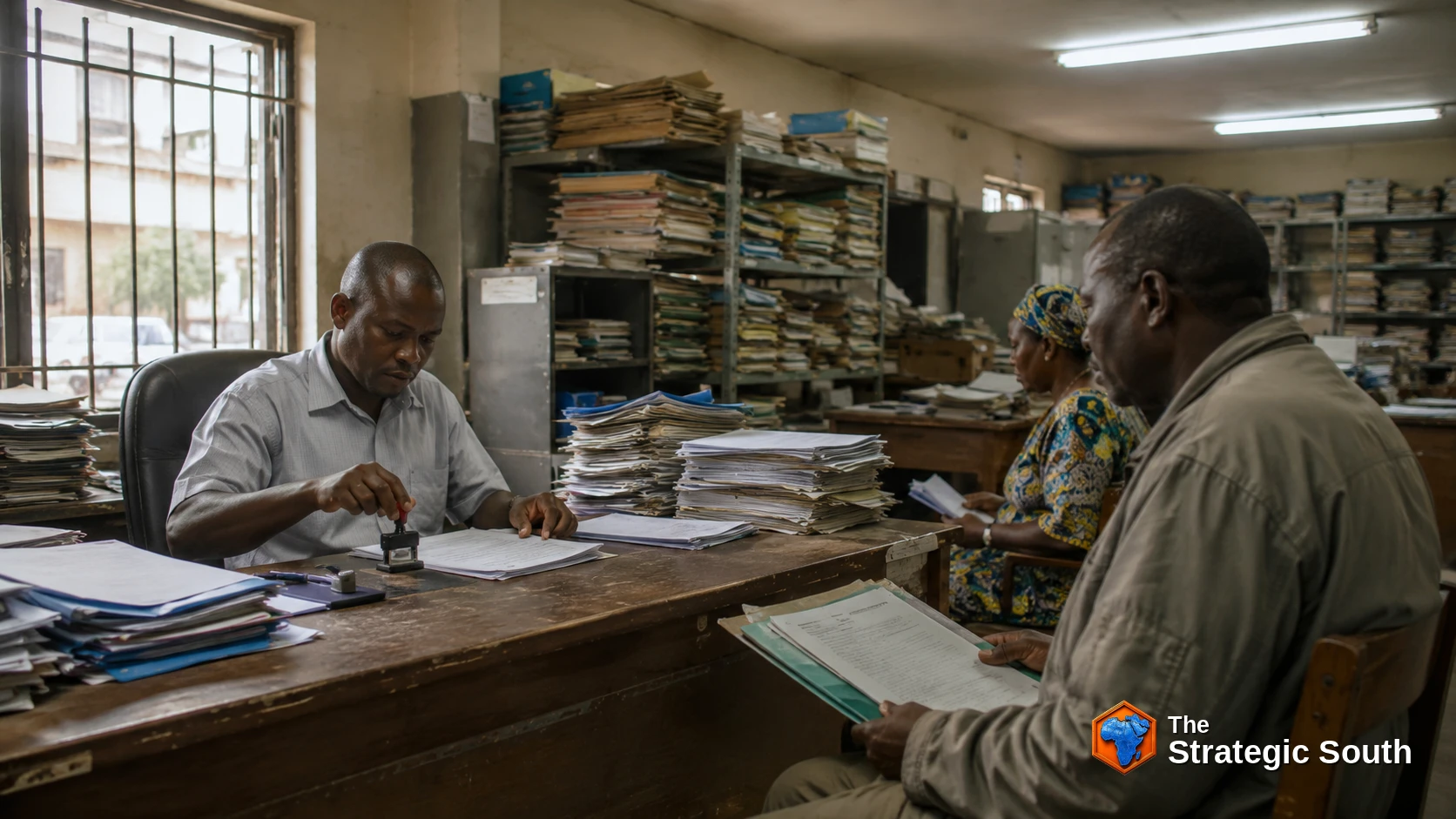
What looks like indifference is almost always an absence of design. A file that needs chasing every day is what a manual, paper-based process produces when it has no single owner, no service level and no consequence for delay. The people inside it are behaving rationally: they do the task in front of them, to the standard they are measured on. Give the same people a tracking number, a deadline and someone accountable for the sequence, and the behaviour changes within weeks. Blame the individuals and you spend your energy fighting an enemy that is not there, and you burn out inside a year having improved nothing.
So you do not copy a delivery model from one geography and paste it into another. You calibrate it to the system in front of you: the follow-up the process does not generate on its own, the buffers the schedule needs because clearance times have a fat tail, the relationships that get a document looked at this afternoon rather than next week. That adaptation is not a soft skill. In Central Africa it is the skill, and it is the one thing on a CV I actually test for.
The durable fix, though, is not a better chaser. It is to build the missing mechanism: a single window in place of ten signatures, a tracked file in place of a paper one, a status anyone can read without phoning a friend, and people trained and kept long enough that the knowledge stays in the building instead of leaving with them. None of that is glamorous, none of it is opened by a minister, and all of it outperforms another kilometre of surfacing.

The kilometre still decides
Go back to that last kilometre. A shipment on the ground. An office you could see from the runway. And a gap between the two that could swallow three months, not because anything stood in the way, but because nothing crossed it unless we crossed it ourselves.
That kilometre is the region in miniature. Douala to N'Djamena, the rail towards Ngaoundéré, the deep water going in at Kribi — none of it is waiting on track that has not been laid. It is waiting on the document that sits until it is asked for, the release that clears only when chased, the handoff that happens on the day somebody remembers it. The distance was never what held the cargo. What holds it is the step between two assets, running on somebody's initiative, in a system where nobody has been told the step is theirs.
So pour the concrete and dredge the deep water. That is the visible half, and it is genuinely needed. The other half is quieter and cheaper: a person at each join whose job — written down, measured, and paid for — is to move the next step before anyone has to ask. Get that right and the kilometre closes in an afternoon. Get it wrong and you can finish every road in Central Africa and still watch a container sit for three months, a kilometre from the people waiting for it.
The Strategic South examines how engineering, infrastructure, energy and industrial systems are reshaping Africa and the Middle East — through the lens of project delivery, not press releases. Subscribe to the weekly newsletter, and explore the companion pieces.