

Alone in a room, an entire engineering centre on the screen
The room is at head office. Most months I am the only person physically in it. On the screen is an entire engineering centre — several dozen people in another country, the ones who design and build a substantial part of the corridor — and they are not happy with me.
They want a claim raised against the client. Several hundred thousand euros. And they want it treated as good money now: invoiced to the client, and in the meantime settled out of our own project's pocket, before the client has validated a single line of it.
The sequence had started politely enough. The claim appeared in a monthly review as a figure with a short narrative attached. I asked for the justification behind it — the instructions that had changed, the dates, the evidence that the change had come from the client's side and not from a decision taken inside the centre itself. What came back was thinner each time I looked at it. There were assertions. There was no file. Nothing the consortium on the ground could put its name to, nothing head office would sign. It was not that the claim was fraudulent. It was that it did not exist in a form anybody outside our own walls could examine.
So I said no. And then I said no in the following month's review, and the one after that, while the pressure moved up a register — first the technical argument, then the commercial one, then the observation that people in that centre had budgets of their own to defend and I was defending mine at their expense. I do not take those debates personally, and I did not take that one home. It is business, not a family affair. The arguments are loud because the money is real, and none of it survives the end of the call.
I held the position until the decision was taken at the level where it belonged, above both of us, on the file as it actually stood. The claim was set aside. Nothing was ever sent.

Why that room existed at all
None of it would have happened in a room like that if the structure had been simpler, and the structure is the point.
The corridor is a freight line connecting a seaport to a landlocked interior. The client is a national railway. Above the work sits a consortium, which holds the contract; we are one integrator inside it. Below, several engineering centres in different countries deliver their portions of the scope. Those centres report up through me. They never speak to the consortium directly, and they never speak to the client at all.
That arrangement is deliberate and it is normal. It also has a consequence people rarely think through when they draw it. Everything a centre wants to say to the client passes through one person, and everything the client's reality has to say back to a centre passes through the same person in the other direction. When a centre is three countries away, has never sat opposite the client's contracts team and has a budget under pressure, a claim looks like a straightforward commercial move. From where I sit, the same claim is a document the client's lawyers will read line by line, and a message about how carefully we check ourselves before we ask them for money.
There was no procedure for that morning. No clause anywhere said what happens when the layer beneath you asks for something the layer above you cannot defend. The layers only behave as one company if somebody stands in the join and takes the decision, in a room where the pressure is entirely one-directional and nobody else is at the table.
A claim is a currency
The discipline underneath the refusal is one I would defend on any project, in any country.
A claim is a currency, and the client's trust is the account it draws on. Every claim you submit spends a little of it, and a claim that cannot be substantiated spends a great deal. The client does not simply reject it and move on. They conclude, reasonably, that your numbers require checking — all of them, from that day forward. Certificates get read twice. Progress declarations get verified. Payment cycles stretch, because verification takes time and the person doing it is no longer inclined to give you the benefit of the doubt. That is the real invoice, and it arrives months later, spread across everything you do.
Paying it ourselves would have solved nothing either. Settling a claim from our own pocket does not make a loss disappear; it moves several hundred thousand euros of somebody else's problem onto our project, and buys a quiet monthly review in exchange for a hole in our own result.
You never send a client a claim you cannot stand behind. Not because sending it is dishonest, but because credibility is a single account and the real claims — the documented ones, the ones where you genuinely are owed — are drawn on exactly the same balance.
A claim is a currency, and the client's trust is the account it draws on.
Reliability is the product
This is why I read East Africa's corridor race the way I do.
The region is not short of ports, and it is no longer short of rail. Mombasa and Lamu, Dar es Salaam and Mtwara, Nacala, Beira and Maputo are all competing for the same landlocked customers — Uganda, Rwanda, Burundi, eastern DRC, South Sudan. The infrastructure gap that dominated the conversation for a generation has narrowed considerably. What has not narrowed is the gap between routes that behave the same way in March as they did in January, and routes that do not.
A shipper does not choose a route because it is impressive, and rarely because it is shortest. A corridor with efficient customs, dependable rail and coordinated borders will beat a shorter congested one every time, and it will keep the traffic after it wins it. Routing decisions are sticky in both directions: they are slow to be made, because someone has to be persuaded to risk a supply chain on a new route, and slow to be reversed, because the alternative has to be demonstrably better for months before anyone will move back. A gateway that becomes dependable for two consecutive years is very hard to displace, whatever the competing brochures say.
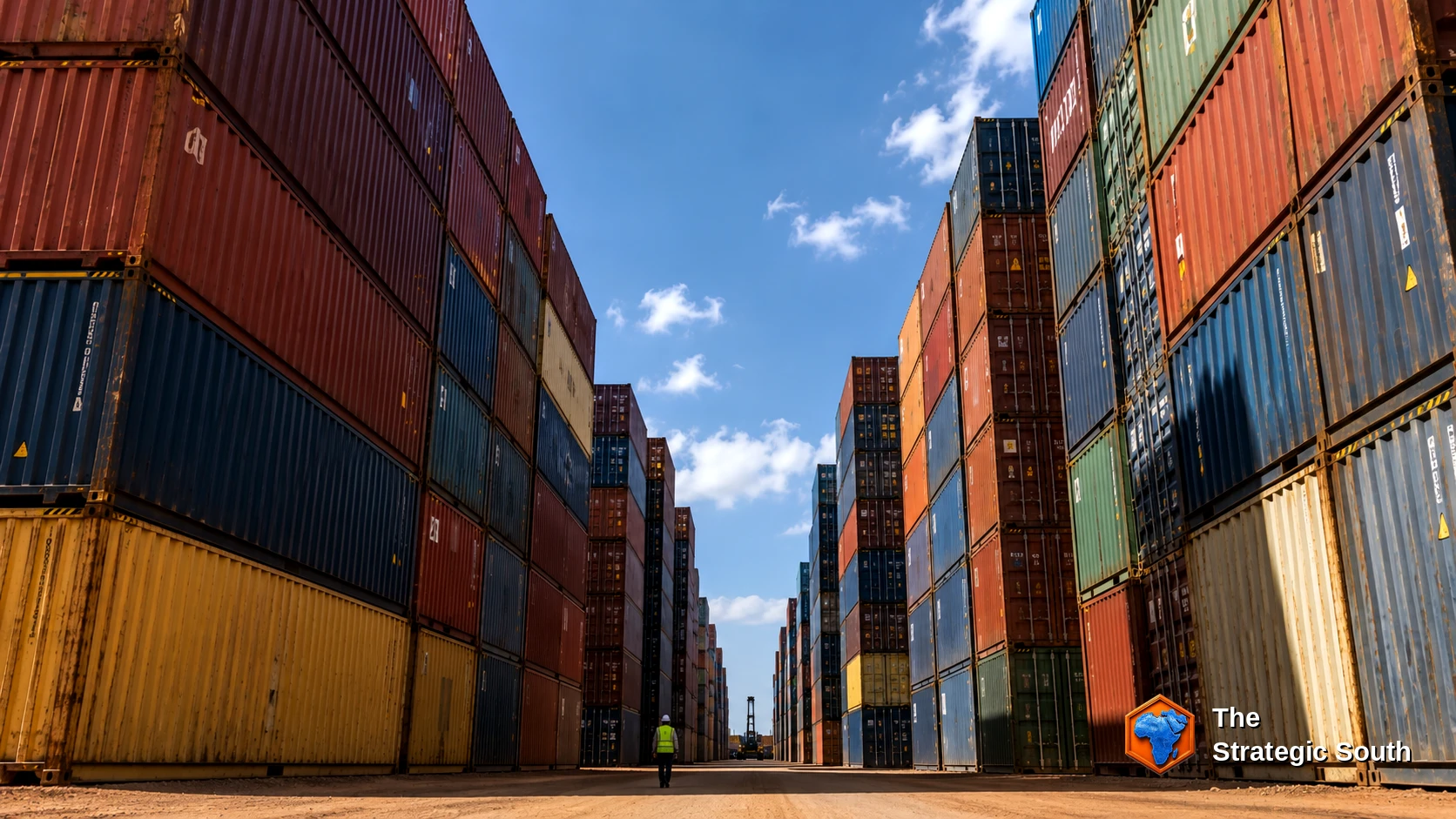
For a manufacturer or a mining operator, a corridor is not a distance to cross. It is a promise to plan around. Can I tell my customer the week the container lands, and be right most of the time? Can I run a plant at the far end of this route without holding three weeks of inventory as insurance against a border? Every day of unpredictability is converted, somewhere down the line, into stock sitting in a warehouse doing nothing — which is the most expensive form of trust there is. A modern port cannot compensate for an unreliable inland leg. A new railway unlocks very little without dependable operations behind it. Reliability is the product. Everything else is the packaging, and the packaging is the part that photographs well.

Reliability is bought at the desk
Here is the connection that took me a while to see, and that the map will never show you.
Reliability is not only an operational property. It is a commercial one. A client who trusts your paperwork releases things faster — approvals, milestones, payments, access to site. A client who has once received a claim they could not validate starts protecting themselves, and protection is expensive in exactly the currency a corridor is judged on: time. The verification loop lengthens, the file waits for a second signature, the sequence slows down, and a route that ran to schedule begins to run to a range.
So the discipline in that room and the transit time a shipper eventually experiences are the same thing, seen at two different distances. Every layer that behaves cleanly towards the layer above it shortens the corridor by a few days. Every layer that pushes an unsupportable problem upstream lengthens it, permanently, because trust is slower to rebuild than a schedule is to slip.
That is not a procedure you can write down and hand over. It is a decision, taken repeatedly, by people who have something to lose by taking it.
Back to the room, and what it was really about
Go back to that morning. One person at a table, an entire engineering centre on the screen, a number on the line that I would not sign.
At the time it felt like a bruising internal fight over a few hundred thousand euros, the kind of thing nobody outside the project would ever hear about. It was not. That room was the corridor compressed into a single interface: one decision about who carries a risk nobody wants, taken by the only person positioned to take it, with no procedure to hide behind. Nothing about it would have looked good from the coast. It does not fit on a map. And the line ran better afterwards, because a claim that could not stand never reached the client — and the next one, the one that was real and documented, was believed on sight.
That is the mechanism East Africa's corridors will actually turn on. Mombasa can dredge a deeper berth. Dar es Salaam can lay new track. Nacala and Beira can court the same landlocked interior with the same slides. None of it answers the only question a shipper is really asking, which is whether the container will be where you said, in the week you said, this month and the next and the one after that.
That answer is not poured in concrete or bolted into rail. It is settled in rooms, by people willing to sit alone with a file that does not hold up and say so, month after month, until somebody senior enough agrees. Build the ports. Lay the rail. Then find the people who will not push a problem downstream to make a review go quietly — because the freight, in the end, follows them.
The Strategic South examines how engineering, infrastructure, energy and industrial systems are reshaping Africa and the Middle East — through the lens of project delivery, not press releases. Subscribe to the weekly newsletter, and explore the companion pieces.